Malaga, Spain: Our Home in Andalusia

Hurricane Ophelia has moved up the Iberian Peninsula and brought rain to the entire region.  It is moving day, 7:00 am, dark and pouring rain outside, so we hailed a cab to take us directly to the train station.  That was the best 7.00 euros we’ve spent so far!  We took a high speed train from Madrid to Malaga, Spain.  The roughly 300 mile trip took a meer 2 hours and 20 minutes, seeing speeds of up to 183 mph. When you are watching the landscape fly by at those speeds, it is quite impressive!  
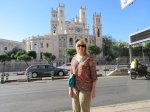
Our train pulled in to the Maria Zambrosa Station in Malaga and we grabbed a coffee and a quick bite before heading to meet Carmen, our host, and move in to our new home.  It begins to rain, so we jumped in a cab again and we’re off.  We pass the water front where cruise ships dock, a beautiful park and we can see the beach area as we turn inland.  Our home in Malaga is a distance from the tourist area, allowing us a better opportunity to experience living as a local.  

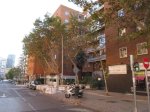
Carmen greets us at the door.  She lives on the ground level and we will be up on the third floor of the building.  Our apartment has stairs up to a fourth floor private terrace and laundry room.  Carmen gives us a tour and has printed out a map to show us where to buy groceries, where to catch a bus, etc.  We are literally next door to the Santuario de la Virgen de la Victoria church, where Carmen is getting married in three weeks!  It has rained most of the day, but clears up long enough to pop over to the supermarket and pick up some supplies for the week.  We are using our time today to plan and catch up on some blogging.  

Madrid, Spain: Retiro Region

We decided to step out of the plazas, squares, and markets to explore one of Madrid’s beautiful parks, Parque de El Retiro, or as Kirk would call it, “retired people’s park”.  The weather was warmer, but there was a nice breeze and we strolled through the many tree-lined paths weaving in and around its 125 hectares.  It is filled with a variety of gardens specializing in certain botanical species or created by a particular historical figurehead or funded by matriarchs/patriarchs.  The park holds the oldest trees in Madrid, the Bald Cypress, which are 400+ years old.

In addition to its natural beauty, you can view other works of art dotted throughout the park, like the Crystal Palace, created in 1887 to house a sample of exotic plants at the Philippine Exposition and is one of the leading examples of iron architecture in Spain.  The Palace of Velasquez was housing an exhibition of a photographer we moved through quickly…not our “cup of tea”.  The Grand Lake there was truly magnificent allowing an opportunity to row your way around under the monument to King Alfonso XII.  We intended to go back when the sun was not so intense, but we were not the only ones with that idea… and I was really looking forward to Kirk rowing me around on the lake, singing loves songs, while I swooned in his presence. 😍😁

We enjoyed the variety of performers throughout the park.  There were jugglers, magicians, balloon sculpters, face painters, and artists of every media. The musicians and singers were out in force also, and we stopped a few minutes to enjoy many of them. Then there were rollerbladers, skaters, skooters, cyclists, joggers, Segway riders and a few other moving contraptions all sharing the park together.

We learned that this used to be the private park of the Monarchy up until the late 19th century.  It was such a beautiful place, I’m not sure, if I were Queen, that I’d want to share it!  We are glad they did!

Toledo, Spain: Day Trip Into History

While in Madrid, and realizing that it holds so many beautiful, amazing, fun things to explore, we have been encouraged by too many people to see Toledo to ignore the opportunity.  Toledo is an ancient city south of Madrid touting “The Most Beautiful City in the World”.  For 41.20 euros, we purchased two round-trip train tickets from Madrid to Toledo.  The Atocha Renfre train station is just two metro stops from our home.  The train station is beautiful, gynormous, and a little confusing. We love traveling by train; there is plenty of leg room, you can move about freely, and it allows you to see the countryside along the way.

Since this was more of an impromptu decision, we did not do any research prior to this trip.  When we arrived (25 minute trip) at the station in Toledo, we decided to jump on the Hop On Hop Off Bus, which was 18.00 euros each for 24 hours.  We decided to ride around one time to check everything out and you can listen to an english guide explain what you are looking at. 

Toledo is set on a hill above the plains of Castilla-La Mancha in central Spain with structures dating back more than 2,000 years, to the beginning of Spain’s history.  Toledo has been home to Roman municipium, the capital of the Visigothic Kingdom, a fortress of the Emirate of Cordoba, an outpost of the Christian Kingdom, and in the 16th century, the temporary seat of supreme power under  Charles V and influences are seen stemming from three major religions – Judiaism, Christianity, and Islam.  There is an excavation site revealing evidence of a tribe of people well beyond the documented Roman influences dating 200 BC.  

In the representation of art, sculpture and architecture, probably the most celebrated in Toledo is the greek artist, Domenicos Theotokopoulos, more commonly known as “El Greco”.  El Greco came to Toledo 1577, where he lived and worked until his death in 1614.  He painted his best known paintings while residing in Toledo.

We took a break from history overload and exploration to enjoy some coffee and treats in the historical Plaza de Zocodover.  Sitting on the terrace of the Mazapan Cafe, we enjoy people watching and listening to the variety of dialects, realizing the world-wide appeal Toledo holds.  It was worth the time to come and take a peek into history, while enjoying the beautiful setting that Toledo presents.

Madrid, Spain: Reunion Day

For our friends in Santa Maria, and in particular, our FCC family, many of you know Sergio and Diane Camacho. In the fall of 2016, they hosted a young man, Carlos Gomez, from Madrid.  He was sweet and charming and we had fun teasing with him while he was here.  One year later, the Camachos agreed to host Carlos’ sister, Ana.  Since Ana was a few weeks shy of 15, the exchange organization required a parent to escort her to California.  The Gomez family all came together to make a holiday of it and we had the pleasure to meet them. Carlos’ parents, Carlos and Marcela, were wonderful and we were glad to see Carlos again, as well as meet Ana. We told them of our travel plans and that we planned to spend a week in Madrid and we made tentative plans to meet there.

I contacted Marcela when we arrived and we agreed to meet on Saturday. I told her we would like to see how a typical family lives here in Madrid.  We left our apartment and took the metro, then walked to their flat. I have to say I love the metro system in Madrid and I love walking through the streets.  There are so many things you miss when you are in a car. Walking allows you to interact with people and see things from a different perspective.

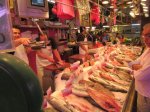
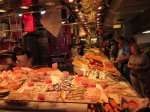
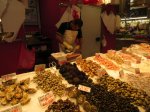
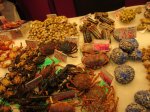
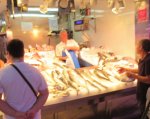
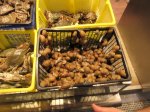
We were greeted with open arms by the Gomez family and had a nice visit and tour of their flat.  We then went for a walk down their street to a typical market, in fact, the one Marcela shops at weekly. We only walked through part of one floor of the two-story market.  It is probably almost the size of a football field if you put the two floors together.  They have everything in there, but Carlos explained how Spain is very important in the fishing industry, with a major presence not only in the Mediterranean and Atlantic, but also in other areas off South America and Africa.  So, the selection of seafood here is phenomenal. Here in the market, you can tell the vendor what you would like and how you would like to prepare it and they will cut and clean it to your specifications, or they can help you with some instructions if you wish to try something new.

After we left the market, it was time for lunch.  (In Spain, lunch is not noon, but 2:00 or 3:00 and dinner is 8:00 or after.) Marcela was excited to show us their very favorite restaurant, and she had to make special arrangements to get a table because they were booked up. We arrived at Lakasa and were seated out on the lovely terrace.  Carlos suggested that we let Chef Cesar Martin decide for us what to try.  Chef Martin suggested that he would bring several things to share and their Sommelier would pair Spanish wines with the various courses.

Now, here is where I’m going to have trouble…the food and wines were so beautiful and wonderful, I was caught up in moment and did not take and pictures or notes.  Also, the descriptions don’t translate well into english. So, I ask the Chef to kindly forgive me for my crude attempt to explain what he served: Chicken and cheese croquettes, bull’s tail on potatoe, chilled tomatoe soup with shrimp, tuna tartar, muscles, quail on rice, and a lobster and chicken dish.  To finish, we had a cheese platter with four types of cheeses paired with a late harvest wine that was like honey.  I must also explain this feast was over the course of almost three hours and the chef would come and personally check on us or even explain and serve the dish himself.  The whole service staff was lovely and accommodating.  I can’t speak for anyone else, but I felt like a queen or a celebrity! (Especially after the parade…lol). Thank you to Chef Martin for your personal attention and your passion for your craft, which was evident in your dishes. I recommend Lakasa if you are looking for an experience and a beautiful meal in Madrid.

Once lunch was over, Carlos and Marcela wanted to show us the Palacio Real de El Pardo where Generalissimo Francisco Franco resided after the Spanish Civil War.  Carlos liked the gardens in particular and Marcela thought it was a good representation of how the royalty lived in those days.  Unfortunately, when we arrived, it was closed but we walked around the area and Carlos explained that today the palace is controlled by the military and is used to house visiting dignitaries.

In addition, Carlos and Marcela gave us suggestions of what to see and do in our remaining days in Madrid along with ideas for the rest of our time in Southern Spain and Barcelona.  I hated to see our day end and really appreciate the time spent together sharing likes and differences, philosophy, culture, and politics, and we all agreed that the world would be a better place if we all would just make an attempt to understand one another.  Contrary to what media chooses to show, the world is filled with wonderful people who are more the same than our differences.

Madrid, Spain: A Parade Held in Our Honor…?

We would like to thank Spain and the city of Madrid for the parade!  It was complete with a military air show and attended by the Royal Family, with representation from every branch of the military, out in full regalia!  We felt SO special!

OK…so it is because October 12th is a National Holiday in Spain.  Over the years, the festival has changed, but Fiesta National de Espana (or Dia de la Hispanidad) commemorates Christopher Columbus’ discovery of the Americas in 1492.  The king of Spain supervises the raising of the flag in the center of Madrid, after which the king and the Prime Minister lead a military parade.

It was cool to see everyone waving the flag of Spain and the thousands of people lined up to view the parade, in spite of the tensions with Catalonia. Later, as we walked through the streets and plazas, we could see flags hanging from the windows and balconies everywhere.  What a glorious way to begin our adventure in Madrid!

On a sad note, one of the jets that flew over crashed upon returning to the air base and the pilot did not make it out of the plane before it crashed. Our thoughts and prayers go out to the pilot’s family and his fellow pilots.  Thank you for your service to your country.

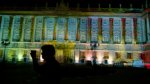
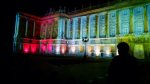
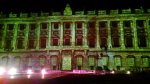
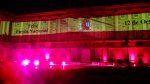
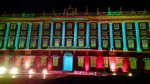
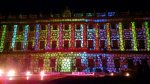
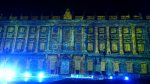
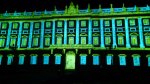
ADDITION TO POST:  The celebration continues! We went out again just before 10 pm and there were thousands out having fun on every street and plaza we passed.  We happened to walk to Palacio Real where they were doing a light show and concert.  The light show was against the palace walls and the music was beautiful guitar music.  See pics below.

Madrid, Spain: Our Home in the Center of Everything!

Wednesday, October 11th – a day of mixed emotions. We are sad to leave the beauty and tranquility of our home in Nazare, Portugal and yet excited to see what is ahead for us as we explore Spain.  The excitment of a new adventure helps to offset the exhaustion of a moving day…because move, we did! 

We woke at 5:30 am to pack up and walk to the bus terminal to catch our bus to Lisbon at 6:50 am.  After a two hour bus ride, we walked to the metro to catch a train to the airport, in which we changed trains along the way. We arrived at the airport in Lisbon with an hour to spare and breezed through security. (Side note: Lisbon airport is probably the most confusing airport we have been in so far.)  Our flight began boarding about 12:00 pm, which was 20 minutes behind schedule for or 12:20 pm flight. It took four buses and and almost an hour to load us in the plane.  We finally took off an hour late.  When we landed, Kirk & I stayed seated to allow people with connecting flights to get off first, then we were off to find the metro station. It is almost 4:00 pm (-1 hour between Nazare and Madrid) when we entered the Tourist Information Office at the metro station).  We purchased 7 day passes for metro/train/bus for 35 euros each and boarded the first of three trains to the Anton Martin Station.  After making all our connections, we emerged from the underground onto our street, Calle Atoche, and headed to 28 to meet Isa and receive the keys to our new home. 

Isa was lovely in every way.  Our new home is in the center of the center of the center!  Our home is a cute and bright studio over the top of bustling shops. It is just after 5:00 pm, which makes this a full day of travel, but Isa gave us some great advice and directions.  We got settled in and then went out to “explore the hood”. We watched street performers, grabbed some delicious sangria and a quick bite, and walked through the streets until after 11:00 pm.  We can already tell we are going to be exhausted this entire week because there is so much to explore!  First impression of the area surrounding Plaza del Sol is they took 500 year old buildings, with beautiful architecture and built Las Vegas in them.  It is a Wednesday night and there are thousands of people out enjoying the night!  And it is past my bedtime! 🤣😂😉

Nazare, Portugal: Putting the “Fun” in Funicular

Today, we rode the funicular up to Sitio to explore the north shore, home to the biggest waves in the world.  Last year, Garrett McNamara broke the world record for the largest wave ever surfed at 100 feet.  Ever since then, Nazare has been on the radar for places we’d like to visit. When we got up to the fort, we could see that there was a competition going on, and realized it was the APB World Championships for Bodyboarding.  We sat in tbe shade of the fort and watched through binoculars, looking down over the competition, and could hear the announcers from the beach.  We felt like we had VIP seats!

Afterwards, we explored the fort and found a big wave surf museum inside, along with information explaining why this spot forms such massive waves.  We went up onto the roof and saw the historic light on top.  We learned more history regarding Portugal.

Further history lessons awaited at the Church of Nossa Senhora da Nazare, which now houses a small Black Madonna, brought from Nazareth.  Legend tells of a Templar Knight, Dom Fuas Roupinho, who was saved, along with his horse, via intervention from Mary, from plumitting 100 meters off the cliff while in pursuit of a deer on a foggy morning on September 14, 1182.

Nazare: More Than Waves

Nazare is known as the place with the biggest waves in the world, but it is also like stepping back in time.  The people of Nazare are keeping the traditions and customs alive here. 

There is a market every morning where the locals go to get their fresh vegetables, baked goods, meats, nuts, fruits, and fish.  We learned we can go every morning and for only a few euro, we can get a delicious, fresh salad, chopped and ready to eat along with some baggets. We found the store across the street has fresh, hot Pastel de Nata for .35 euro, which is the best price for the best ones we’ve had so far.  

The women dress in traditional skirts with seven layers of petticoats.  They filet the fish and lay them out out drying racks on the beach, which we can see from our balcony.  You can wander down the street and see the women knitting and sewing items for sale.  The men are painting miniature fishing boats. Everyone is friendly and greets you, but you are not hounded or bothered while you look. 

The sand on the beach is clean and beautiful.  The pace here is slower and the sunsets have been breathtaking.  We will definitely come back and spend time here again!

Nazare, Portugal: Our Home on the Beach

We left Lisbon via a hike down the hill to the metro, metro to the bus terminal, and a two hour bus ride to Nazare – home of the biggest waves in the world. It was only a short walk to beach and we met Patricia, who gave us the keys to our home this week. Well, it didn’t take more than a minute to realize we SCORED!

Lisbon: Ferry Ride to Almada

Kirk wanted to check out the statue of Christ, “Cristo Rei” (Christ the King) which was modeled after the Chrst the Redeemer statue in Rio de Janeiro, Brazil.  Today’s adventure would take a trolly, the metro, a ferry and a bus ride. This also took us through the beautiful Praco de Comercio, a large square opening up Lisbon to tbe Targus River, bustling with activity.  The impressive city gateway that draws you in ftom the square, the mosaic work as far as you can see, the statues, street artists -they are all a lot to take in along the way.  And a little history lesson:

The 25 de Abril Bridge, the Golden Gate look-a-like, was opened in 1966, with the train tracks underneath added later in 1999.  It was built by The American Bridge Company and spans 2,277 meters across the Tagus river connecting Lisbon to Almada. The bridge was originally named Salazar Bridge until 1974, and renamed to commemorate the Carnation Revolution.

The Cristo Rei is a monument dedicated to God for saving Portugal from the effects of WWII – Portugal did not participate. The construction was approved in a Portuguese Episcopate conference held in Fatima on April 20, 1940, as a plea to God to release Portugal from entering WWII, however it was not until 1952 that construction began.